
Last updated
A dive watch with glowing hands, a set of night sights on a service pistol, a glowing keyring on a set of car keys in a carry-on bag: sealed tritium passes through airports every day, often without its owner giving it a thought. A tritium vial is a sealed glass tube that glows without a battery, the same type used in watch hands. Aviation itself has used tritium instrument markings for decades.
The question still comes up. What follows covers what happens when a sealed tritium item goes through an airport, what varies by airline and by country, and what is worth checking before you pack.
This article describes how screening and rules generally work. It is not legal advice, and rules change, so for anything unusual check with the airline and the relevant national regulator directly.
Will a tritium keychain set off airport security?
No, neither of the systems at a checkpoint reacts to tritium.
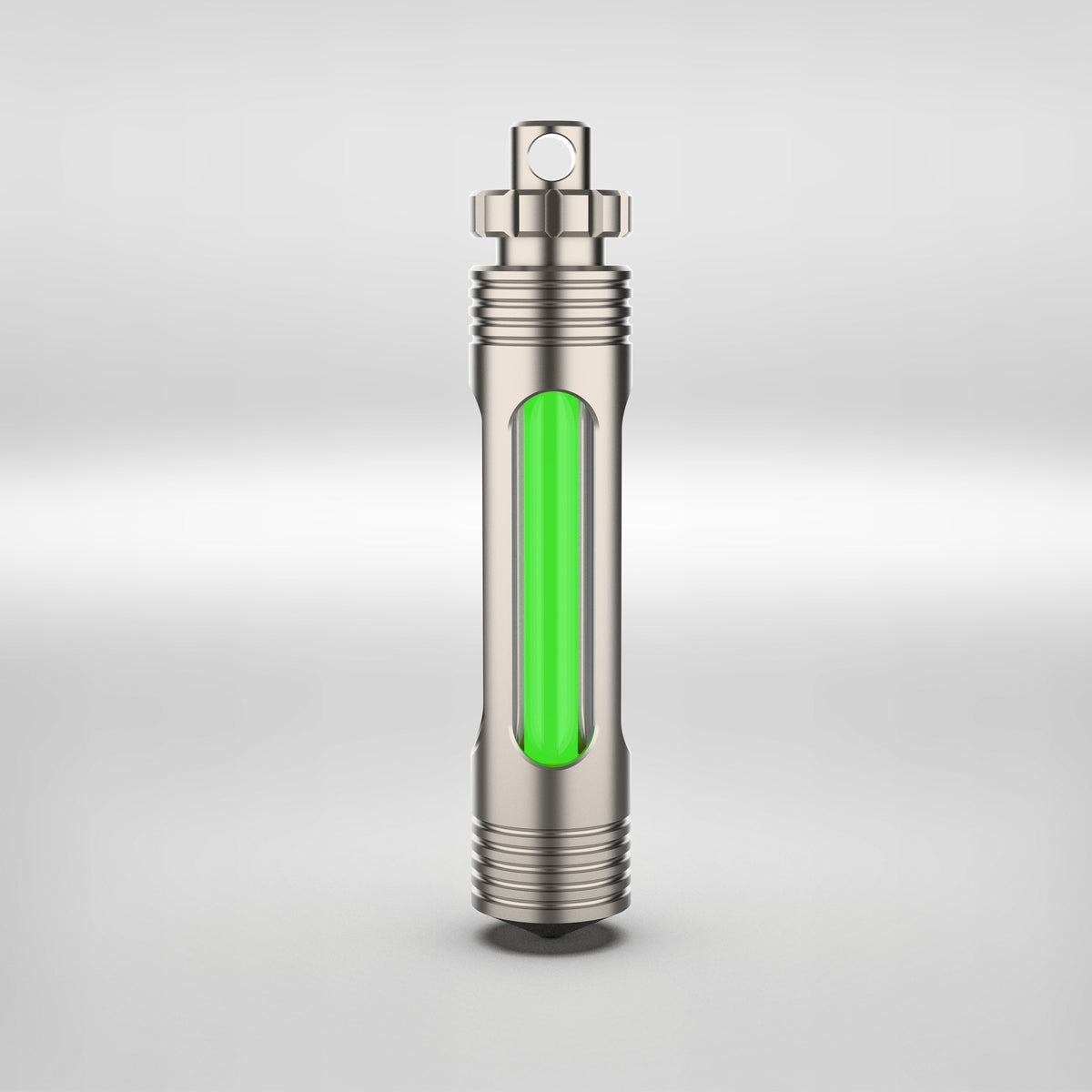
X-ray and CT scanners image the shape and density of what is in your bag. A tritium keychain shows up as what it is, a small metal object with a tiny glass tube inside, and nothing in that image resembles a prohibited item. The scan does not affect the vial: X-rays do not degrade the glow or the seal, and they do not affect glow-in-the-dark material either.
Radiation portal monitors, where they are used, look for penetrating gamma and neutron radiation from sources of security concern. Tritium produces neither. Tritium emits beta particles that cannot pass through the glass or through skin. Nothing leaves a sealed item for a monitor to register. A sealed vial in normal use is not a radiation exposure risk. The physics behind that is in our guide to whether a tritium keychain is safe.
Metal detectors respond to the housing, exactly as they would to a keyring, a belt buckle or a coin.
The published prohibited-items lists are worth reading precisely. Screening authorities list the categories that are restricted or banned, and small sealed self-luminous consumer devices do not appear on them as radioactive material. Those radioactive-material entries are aimed at the licensed sources used in industry and medicine, shipped as dangerous goods with documentation. A keyring vial is not in that category, so at the checkpoint it can simply go through without comment.
Should tritium go in carry-on or checked baggage?
Carry it on, for reasons that have nothing to do with regulations.
A tritium vial is small, sealed glass. It is well protected inside a machined housing, but checked baggage takes impacts that carry-on does not, and the hold is the wrong place for a fragile item you care about. The two ends of a vial are the sealed points, and they break far more easily than the straight body. The failures we see come from clamping the ends during installation, and from drops. Cabin pressure and altitude have no effect on a sealed vial, so the concern is handling alone.
Being present matters as well. If a screener has a question, you want to be standing there to answer it, whereas an item flagged in checked baggage is resolved without you, which takes longer and can mean a bag opened and repacked.
The exception is the housing itself. If your fob is built around a knife blade, a pry bar with a sharpened edge or anything tool-shaped, that part may not be allowed in the cabin, and it is the tool, not the tritium, that causes the problem.
What can cause trouble at the checkpoint with a tritium fob?
Friction at the checkpoint can come from the housing, from unfamiliarity or from volume, and radiation is not on that list.
Tool-shaped housings. Multi-tool fobs, prybars and anything with an edge are judged by the cabin rules for tools and sharp objects. A plain tritium keychain with no blade or edge can go through without trouble, while a fob with a cutting edge may not.
Unfamiliarity. A glass vial that glows without a battery is an unusual object on a scanner screen, and it can prompt a question. A calm one-sentence explanation can end the conversation.
Volume. One vial on your keys is unremarkable. A bag of loose bare vials looks like a shipment rather than a personal item, and it invites questions about import rules at your destination. If you are moving stock rather than carrying gear, that is a shipping question, not a travel one. We inspect every single vial on arrival, and the defects we find are shipping damage.
Are airline rules different from TSA screening rules?
Yes, the two are separate systems, and they are easy to conflate.
Screening authorities decide what may pass the checkpoint. Airlines set their own conditions of carriage, which can be stricter, and they are the final authority on what travels on their aircraft. An airline can treat a sealed consumer tritium item as an ordinary personal effect, and aircraft themselves have long used tritium markings on instruments and exit signage.
Airline rules do bite on quantity and on the housing. Anything that could be described as a commercial quantity of radioactive material, or a fob that is functionally a knife, falls under a rule that has nothing to do with the glow. If you have any doubt, the airline's dangerous-goods page or customer service line can answer quickly, and getting that answer before the airport is cheaper than getting it at the checkpoint.
Can you fly internationally with a tritium keychain?
Screening technology and procedure are broadly similar worldwide, so the airport is not where countries differ. The law on possessing and importing the device once you land is where countries differ.
The United States permits consumer tritium products distributed under Nuclear Regulatory Commission licensing, and the Federal Aviation Administration and Transportation Security Administration between them handle the aviation side. The United Kingdom regulates radioactive substances through the Environment Agency and its devolved equivalents, with the Civil Aviation Authority covering flight. Canada's regulator is the Canadian Nuclear Safety Commission. In the European Union, rules follow national implementations of the EU basic safety standards, so they differ country by country, and a few jurisdictions elsewhere in the world restrict tritium consumer products more tightly.
| Market | Regulator |
|---|---|
| United States | Nuclear Regulatory Commission |
| United Kingdom | Environment Agency |
| Canada | Canadian Nuclear Safety Commission |
| European Union | National regulators |
Carrying a personal item through an airport and bringing tritium devices into a country that restricts them are separate matters, and the second is where the law applies. Our country-by-country legality guide goes through the major markets and names the regulator for each, which makes it a good starting point if you are travelling somewhere new.
What should you check before flying with tritium?
Check the housing, the quantity you carry and the rules at your destination, and keep the fob in your carry-on.
- Keep it in your carry-on, on your keys or in an easy-to-reach pocket of your bag.
- Check the housing, not the vial: no blades, no sharpened edges, nothing tool-shaped in the cabin.
- Carry one, not a box. Personal quantity, personal item.
- Protect the ends of a bare vial: they are the sealed points and break far more easily than the straight body.
- Know your one sentence: "It is a sealed glass vial that glows without a battery, the same type used in watch hands."
- Check the destination, not just the departure airport, when you leave your home country, and especially for the EU and Asia.
- Leave a little extra time if it is your first flight with an unusual-looking fob.
When flying with tritium keychains of the ordinary kind, none of it may ever come up, and the fob goes through the scanner with the coins and the phone charger.
If travel is part of your life, favor a plain, no-edge housing and a vial size you can live with. Larger vials read brighter to the eye: a 3x22.5 mm vial is visibly brighter than a 2x12 mm one. Green is the brightest color at every vial size, which is why we lead with green. Both choices are covered in the tritium keychain buying guide, and you can compare the travel-friendly designs directly in the full collection.
Share:
Tritium vs Glow-in-the-Dark Paint: What Actually Lasts