
Last updated
Put a freshly charged glow-in-the-dark keyring next to a tritium one and the comparison looks settled in about two seconds: the glow paint is dramatically brighter. Come back four hours later, in the dark, and the result has reversed. The paint is a faint smudge you have to hunt for, and the tritium is as bright as it was when you left.
Glow paint is a pigment that stores light; a tritium vial is a sealed glass tube that makes its own. Both technologies are legitimate, but they answer different questions, and glow paint wins some of them.
How do glow paint and tritium make light differently?
Glow paint releases light it has absorbed earlier, while tritium makes light continuously from radioactive decay.
Glow-in-the-dark material is photoluminescent. Modern versions use strontium aluminate pigment suspended in a resin or paint binder. Light hits the pigment, electrons are pushed to a higher energy state, and they fall back down slowly, releasing that stored energy as visible light. The important word is stored: the material is a battery for light, and like any battery it has to be charged and it runs down.
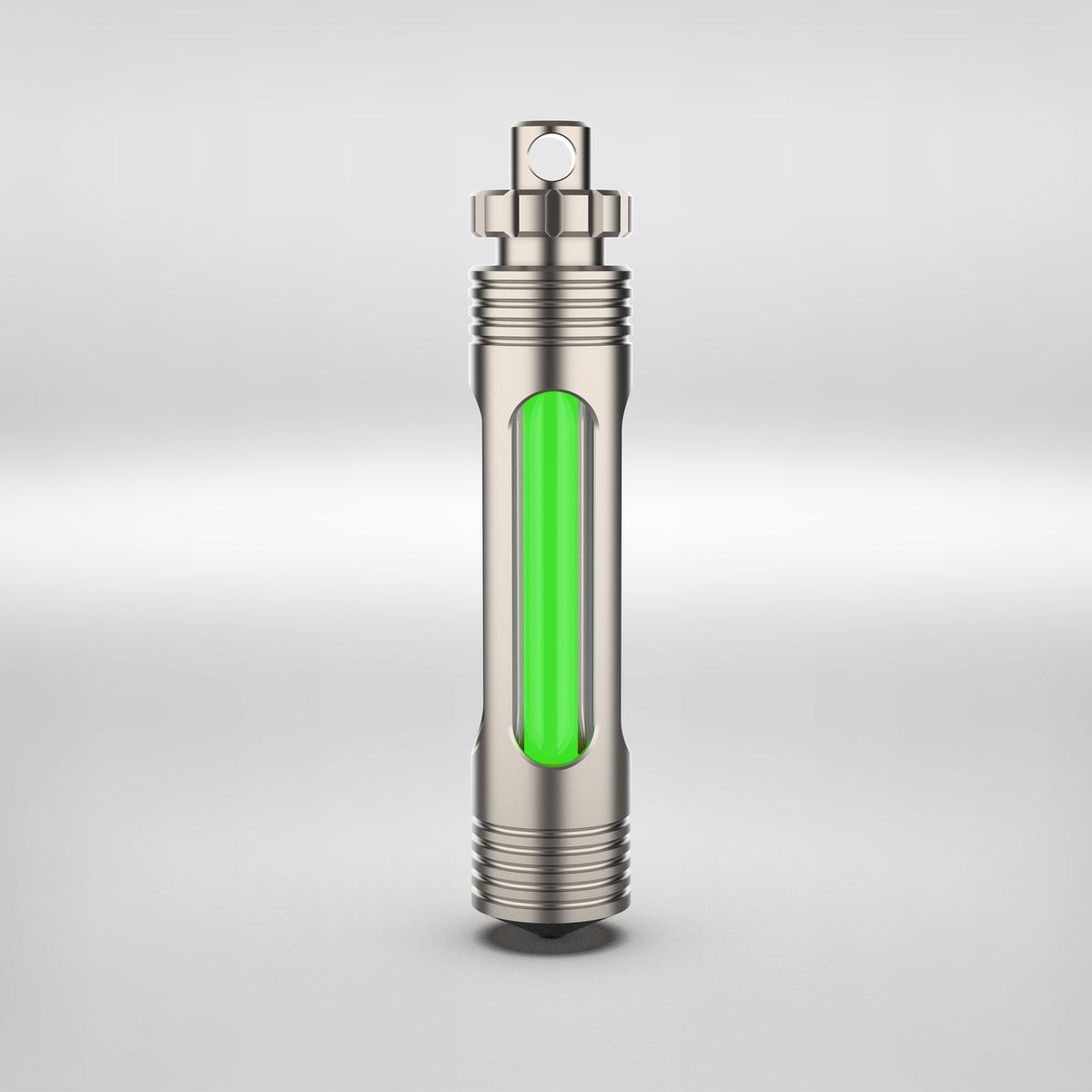
Tritium is radioluminescent. A sealed borosilicate glass vial holds tritium gas and a phosphor coating on the inside wall. Tritium decay releases low-energy electrons that strike the phosphor continuously, and the phosphor converts that energy into light. Nothing is stored, so nothing needs charging and nothing runs down over a night. The supply of tritium declines slowly over years, which is why the glow lasts up to 25 years rather than forever. So the common question "does tritium need to be charged" has a plain answer: no, not by sunlight and not by a lamp.
Which is brighter over one night, glow paint or tritium?
Glow paint is brighter just after the lights go out, and tritium is brighter for the rest of the night.
| Glow-in-the-dark paint | Tritium vial | |
|---|---|---|
| Right after bright light | Very bright, clearly the winner | Modest, steady |
| Later in the evening | Fading noticeably | Unchanged |
| Hours into the night | Faint; needs dark-adapted eyes | Unchanged |
| Middle of the night | Effectively invisible | Unchanged |
| Never exposed to light that day | Nothing at all | Unchanged |
Freshly charged glow paint can be brighter than tritium by a wide margin at first. Glow pigment starts high and decays steeply, fastest in the first minutes before it flattens into a very dim tail. Tritium starts lower and stays flat, and the crossover can come well inside the first hour.
A tritium vial also looks less impressive in a lit room than it is. In strong light you cannot see the glow, although the vial is glowing the whole time. Vial choice moves the starting point, too. Larger vials read brighter to the eye: a 3x22.5 mm vial is visibly brighter than a 2x12 mm one. Green is the brightest color at every vial size, which is why we lead with green.
Which curve you want depends on when you need the light. If you want a bedside item to look bright when you turn the lamp off, paint is the better choice. If you want to find your keys at 3 a.m. after they have been in a dark bag since noon, paint gives you nothing, and tritium gives you the same glow it always had.
How many years do glow paint and tritium last?
Tritium glows for up to 25 years; glow pigment can also last many years, but on pocket gear its paint binder wears out first.
Glow pigment does not die quickly. Strontium aluminate keeps charging and discharging for a long time, and quality pigment can perform for many years. What fails first is the surrounding material: paint binders yellow, chip and abrade, and on an item that lives in a pocket with keys, that wear can show within a few years. Repeated UV exposure also gradually reduces the pigment's output.
Tritium declines in a different way. There is no wear surface, because the glowing part is sealed inside glass. No customer has come back to us reporting a vial going dim. Every vial does dim, though: output falls steadily as the tritium supply decays, so the glow lasts up to 25 years and fades gradually rather than failing, and the vial is either intact and glowing or mechanically broken. The full curve is in our guide to tritium vial lifespan.
Why does tritium cost more than glow paint?
Tritium costs more because the vials are laser-sealed glass from specialist manufacturers and need a machined housing, while glow paint is a cheap pigment.
A pigment-loaded resin insert adds very little to the price of a product, which is why glow-in-the-dark versions of so many things sell at low prices.
The vials are borosilicate glass filled under licensed conditions, and they are small, fragile components that need a machined housing to survive daily carry. The two ends of a vial are the sealed points, and they break far more easily than the straight body. A quality tritium keychain is a metal part with a precision pocket in it, not a molded body with pigment poured in.
Vials are not all equal either. We have handled cheaper non-Swiss vials, and the plain difference is that they are not as bright as ours.
So the fair question is less "which is better value" than "what are you buying". Paint buys a bright burst on demand for very little money. Tritium buys a light that stays on, unattended, for the next couple of decades.
Is tritium less safe than glow paint?
No: in normal use neither one is a safety concern.
Modern glow pigment is non-radioactive and chemically inert, and that is one likely reason it replaced older glow technologies. A glow-in-the-dark keyring is not a safety concern.
Tritium is radioactive, which sounds worse than it is once you look at the kind of radiation involved. Tritium emits beta particles that cannot pass through the glass or through skin. A sealed vial in normal use is not a radiation exposure risk. Consumer tritium products in the US are distributed in compliance with US NRC requirements, owning one asks nothing of you, and the one handling rule is not to crush or machine a vial on purpose. Our guide on whether a tritium keychain is safe covers the physics and the broken-vial scenario in full.
A comparison that sells one by making the other sound dangerous is selling, not comparing.
Should you choose tritium or glow-in-the-dark paint?
Choose glow paint for items used right after lights out, and tritium for items you must find after hours in the dark.
Choose glow-in-the-dark when:
- The item spends its time in lit rooms and gets used shortly after lights out.
- You want maximum visual impact and a large glowing area for the money.
- It is decorative, and a bright green shape matters more than reliability at 4 a.m.
- You are marking something big, such as a light switch surround, a trail marker or a tent zipper.
Choose tritium when:
- The item has to be findable after hours in a dark pocket, bag or drawer.
- It has to work somewhere that never sees light, like a bag interior or a basement.
- You want to install it once and not think about it again for years.
- You are marking something small and important: keys, a bag pull, a tool you locate by touch.
The combination can beat either one alone. A fob with a glow-in-the-dark insert next to a tritium vial gives the bright burst when you leave a lit room and the steady marker for the rest of the night, and several designs in the full collection use both materials in the same body. Glow paint is bright, cheap and empty by the middle of the night unless you keep recharging it; tritium is dimmer at the start, indifferent to whether it has seen daylight, and still doing the same job in ten years. If finding the thing in the dark is the requirement, start with what a glow fob is and how it is built.
Share:
Tritium Vial Lifespan: How Long Does the Glow Really Last?
Can You Fly With Tritium? TSA and Airline Rules