
Last updated
In this guide
- How long does a tritium vial really glow?
- Why does a tritium vial fade instead of switching off?
- Does vial size change how long a tritium vial lasts?
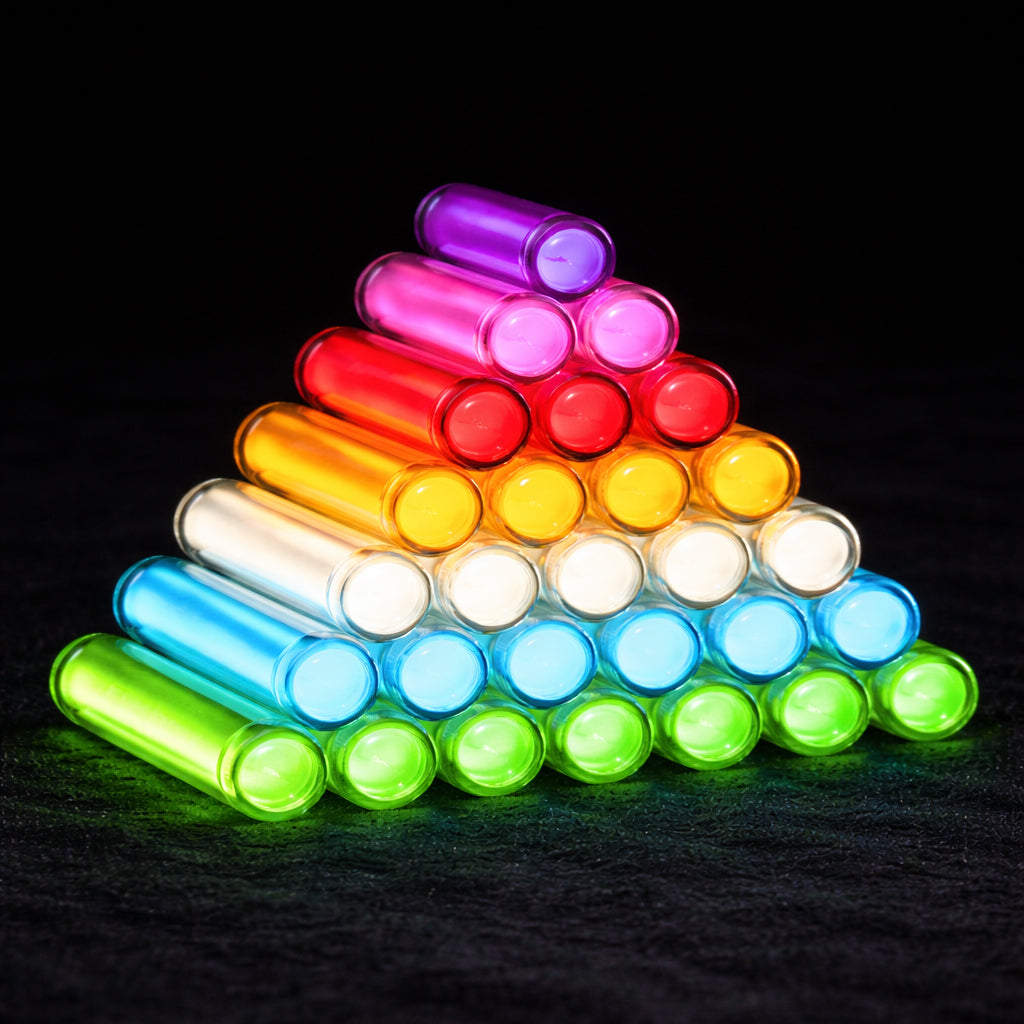
- Does tritium color affect brightness and lifespan?
- What shortens a tritium vial's useful life?
- When should you replace a tritium vial?
- How can you tell a lasting tritium vial from a cheap one?
A tritium vial that went onto someone's keys in 2020 is still glowing tonight. It is dimmer than the day it arrived, and the owner may only find out by reaching for their keys in a dark room and having to search for a green dot that used to be obvious.
A tritium vial is a sealed glass tube of tritium gas that glows with no power source. The tritium vials in keychains, watch faces and gun sights glow for up to 25 years with no charging, no batteries and no maintenance of any kind. Brightness drops a little every year, slowly enough that nobody sees it happen.
How long does a tritium vial really glow?
A tritium vial glows for up to 25 years, getting a little dimmer every year rather than switching off at the end. That is the figure behind every answer to "how long do tritium vials last", and the gradual fade along the way matters as much as the end date.
A gaseous tritium light source, or GTLS, is a sealed borosilicate glass tube with tritium gas inside and a phosphor coating on the inner wall. As the tritium decays it releases low-energy electrons, beta particles, which strike the phosphor, and the phosphor gives off visible light. There are no wires, no switch and no power source outside the glass. Those beta particles cannot pass through the glass or through skin. A sealed vial in normal use is not a radiation exposure risk.
Because the light comes from decay, a vial is at its brightest on the first day and gets dimmer from then on, whether it is on a keyring or still in a drawer. Our vials are fresh from the Swiss factory, and we sell through them, so there is no ageing stock: a vial of ours has not been sitting on a shelf before it reaches you.
"Up to 25 years" is the service window: the span over which a well-made vial of a useful size stays bright enough to do its job in a dark room. Nothing happens at the end of it. A vial does not go dark when the window closes, and an older one is not half-broken, only dimmer than it was.
Tritium decays into helium-3 at a steady rate, so every year there is less tritium in the glass, and no manufacturer can engineer around that. What a manufacturer does control is how much tritium goes in, how efficient the phosphor is and how well the seal holds. Those three choices are why two vials of the same nominal size can look noticeably different after a decade.
Why does a tritium vial fade instead of switching off?
A vial fades gradually because its tritium decays at a steady rate and its phosphor slowly wears out.
Part of the fade is arithmetic. A decay that has already happened cannot happen again, so fewer electrons reach the phosphor each second and less light comes out. That part is predictable, and it is the same for every vial, whoever made it.
The phosphor wears out as well. The coating sits under constant electron bombardment for its whole life, and that slowly erodes its ability to turn energy into light. Phosphor quality can vary more from one manufacturer to the next than tritium fill does, and it is one likely reason a cheap vial fades faster than its specification suggests.
Your eyes soften all of this. Night vision does not respond in a straight line: halve the light a vial puts out and it does not look half as bright, because perceived brightness falls much more slowly than measured output. A vial that has lost a large share of its original luminance can still look clearly lit in a properly dark room.
Does vial size change how long a tritium vial lasts?
Yes: size has a large effect on useful lifespan, and it is an easy specification to skip past.
Vials are described by diameter and length in millimeters. A bigger vial holds more tritium gas and has more phosphor surface, so it starts brighter; and since every vial fades along a similar curve, starting higher keeps it above the point of usefulness for longer. Larger vials also read brighter to the eye: put a 3x22.5 mm vial next to a 2x12 mm one and the larger vial is visibly brighter. 1.5x6 mm is one of the sizes we use often, alongside 2x12 mm and 3x22.5 mm. In practical carry terms:
| Vial size | Format | What to expect |
|---|---|---|
| 2x6 mm | Small | A marker dot on a watch bezel or small insert; first to turn faint with age |
| 3x11 mm | Standard keychain size | Best balance of visibility, cost and housing size |
| 3x22.5 mm | Large | Distinctly brighter, and still performs late in its life |
For the longest useful life, buy the largest vial your housing accepts. It costs more up front, and it bends the fade curve in your favor for as long as you own it.
Does tritium color affect brightness and lifespan?
Yes: color changes brightness as much as size does, because each color uses a different phosphor and the gaps between them are large. Green is the most efficient phosphor available, and it also sits near the peak sensitivity of human night vision, so it wins twice: more light comes out, and your eyes are better at seeing it. The rest rank like this:
| Color | Brightness |
|---|---|
| Green | Brightest |
| Ice blue | Visibly dimmer than green but still strong |
| Yellow | In between |
| Red, orange, purple | Dimmest, sometimes dramatically so |
Green is the brightest color at every vial size, which is why we lead with green.
For lifespan, this matters because a dim color starts out closer to the edge of usefulness. Take a purple vial and a green vial of the same size, made on the same day, and the purple one stops being useful years earlier.
None of that makes the dim colors a mistake. If you want a multi-color collection or a particular look, choose that color and go up a size. A red 3x22.5 mm vial is a more sensible long-term choice than a red 2x6 mm one. The full ranking is in our guide to tritium colors and brightness.
What shortens a tritium vial's useful life?
Mechanical damage, a poor seal and cheap phosphor are what shorten a vial's useful life; a well-made vial in a proper housing has few other ways to fail.
Mechanical damage. A cracked vial vents its tritium and stops glowing. It is the only true sudden death for a GTLS, and it is why the housing matters as much as the vial: a Grade 5 titanium shell around the glass takes the drops and pocket knocks that would otherwise reach it, and a bare vial glued into a soft aluminum body does not. The two ends of a vial are the sealed points, and they break far more easily than the straight body, so a knock on an end is the one to worry about.
Seal quality. A laser-sealed vial from an established manufacturer holds its fill. A badly sealed one leaks slowly and dims long before it should. Nobody can see a weak seal by looking at a vial, new or old, which is the practical argument for buying vials whose source is named.
Cheap phosphor. A vial that looks great in the product photo and has clearly faded three years later more likely has a phosphor problem than a tritium problem.
Temperature, sunlight, water and airport security are not on that list. Nor does leaving it in a bright room, a worry borrowed from glow-in-the-dark materials: tritium has no charge to lose. The difference is covered in our comparison of tritium and glow-in-the-dark paint.
When should you replace a tritium vial?
Replace a vial when you have to hunt for it in a properly dark room, because by then it has aged past the point where it earns a place on your keys.
No customer has come back to us reporting a vial going dim. Every vial does dim, though, and with no service interval to follow the call is yours. The test is simple: go into a properly dark room, give your eyes a minute to adjust, and look for the vial. Daylight tells you nothing: in strong light you cannot see the glow, although the vial is glowing the whole time. If you find it immediately, it is still doing its job.
Small or dim-colored vials can reach that point sooner, and large green ones later. Some collectors swap early for maximum brightness, while someone who carries a fob as a night marker may keep the same vial for longer than they expected.
Replacement is only worth planning for on hardware built to allow it. A tritium keychain with a removable retaining screw takes a new vial in a couple of minutes with hand tools. Handle the new vial by its straight body and keep pliers and clamps off the ends: the failures we see come from clamping the ends during installation, and from drops. A sealed, glued or potted housing does not, and when its vial fades the whole product is finished. If you mean to keep it, buy the design you can service.
How can you tell a lasting tritium vial from a cheap one?
A lasting vial comes from a named source, with its size and color stated and a glow claim of "up to 25 years" rather than "lifetime glow".
Specification sheets in this category range from careful to fictional. "Up to 25 years" describes a service window honestly. A flat "lasts 25 years", or worse, "lifetime glow", describes marketing.
A listing should name its vial source. Vials from established Swiss manufacturing have a track record; unspecified vials have none, and phosphor quality is one place the cost can be cut. We have handled cheaper non-Swiss vials, and the plain difference is that they are not as bright as ours. Every vial we sell has also been inspected on arrival from the Swiss factory, and the defects we find at that point are shipping damage.
A listing that will not state the vial's size and color may be hiding a smaller vial than the photo implies. A vendor that sells replacement vials expects you to still own the product in a decade.
For hardware rather than a bare vial, the buying guide walks through housings, vial sizes and what drives price, and the full collection shows the sizes and colors side by side.
Frequently asked questions
Can a tritium vial be recharged or refilled?
No. The vial is laser-sealed at manufacture and cannot be refilled, recharged, or serviced. When a vial fades past usefulness the fix is replacement, which on a fob with a removable housing is a simple mechanical swap.
Share:
Tritium Glow Fob: How to Choose a Titanium Keychain That Glows for Years
Tritium vs Glow-in-the-Dark Paint: What Actually Lasts