
Last updated
In this guide
- What is a tritium glow fob?
- How long does a tritium glow fob keep glowing?
- Is titanium better than brass, steel or aluminum for a fob?
- What should you look for when choosing a tritium glow fob?
- What is the Antdesign titanium keychain glow fob?
- Is a tritium glow fob safe to carry every day?
- Which tritium glow fob suits the way you carry?
In daylight a tritium glow fob looks like very little: a small titanium body with a sliver of glass set into it. In strong light you cannot see the glow, although the vial is glowing the whole time. Turn the lights off and it is there on the keyring, glowing, without a battery, a switch or any need to charge it under a lamp first.
That simple idea still leaves room to buy badly, and whether glow fobs are worth it comes down to how that idea is built. The difference between a good glow fob and a disappointing one can come down to the housing material, the vial, and how the piece is finished and mounted.
What is a tritium glow fob?
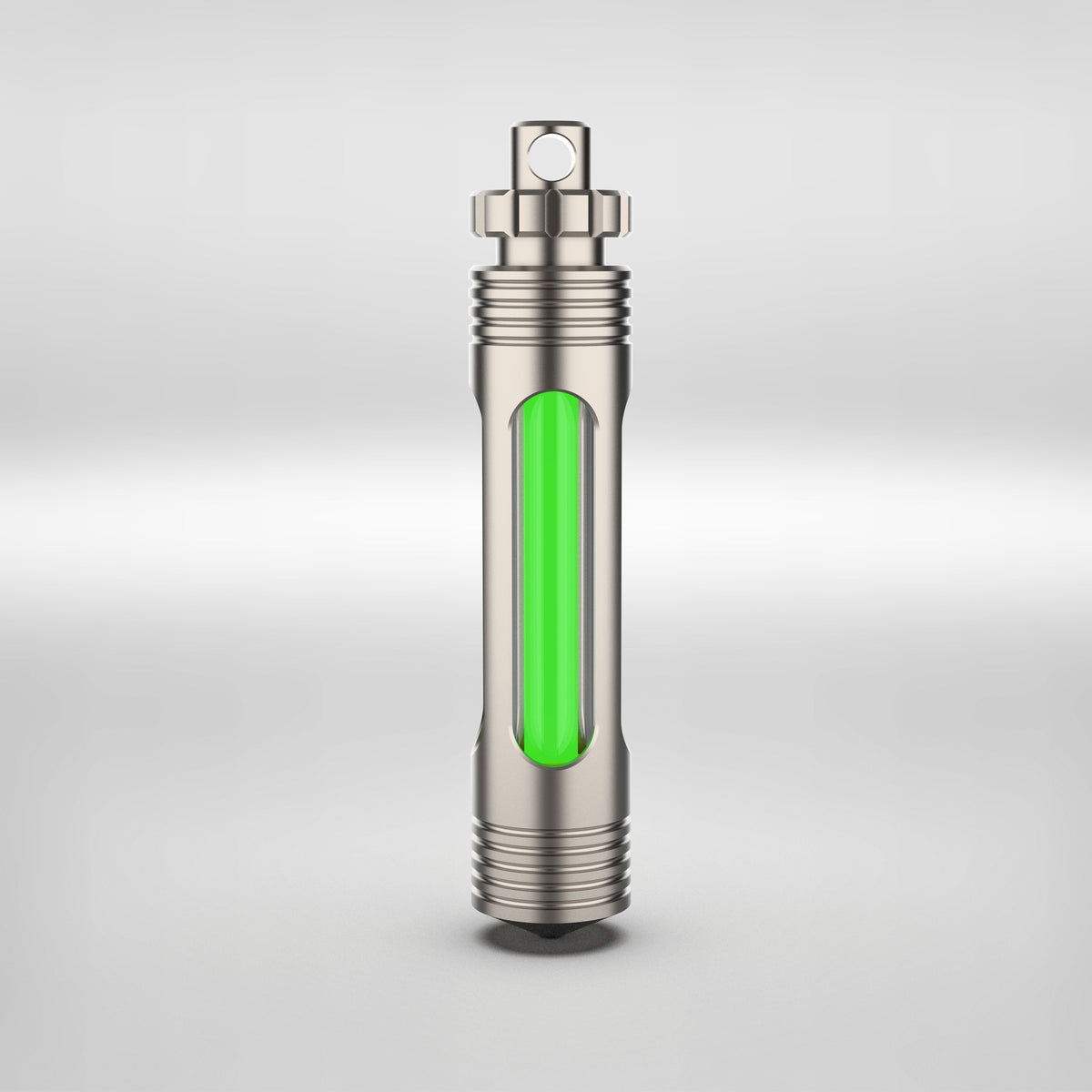
A tritium glow fob is a compact metal housing that holds a sealed tritium vial and is designed to live on a keyring, bag zipper or lanyard. The vial itself is a small glass tube filled with tritium gas and coated on the inside with a phosphor layer. As the tritium decays, it emits low-energy electrons that strike the phosphor and cause it to glow, similar in principle to an old watch dial, but self-contained and always on.
Because the glow does not depend on exposure to light, a tritium glow fob works the same in a dark backpack, a glovebox or a drawer as it does hanging visibly from a keyring. That constant, no-maintenance glow is one likely reason people choose a tritium fob over a glow-in-the-dark paint pull tab or a small LED light.
People carry one in a few recurring ways: clipped to a keyring to find a lock in the dark, hanging from a bag zipper pull so a backpack is easy to spot at night, or tucked into an emergency kit as a passive marker. Each use works because the fob does nothing until it is needed. Then it is simply there, glowing, with no button to press and no battery to check.
How long does a tritium glow fob keep glowing?
The glow duration on a genuine tritium glow fob is rated at up to 25 years. Swiss GTLS (gaseous tritium light source) vials are used across the category, and their sealing quality and phosphor consistency are one likely reason for that. The brightness is strongest early on and fades gradually across that span rather than cutting off at a hard deadline, so a fob you pick up today will still be usable well into the future, just dimmer than when it was new. No customer has come back to us reporting a vial going dim.
This is worth understanding before you buy, because some listings frame tritium glow in terms of half-life, which can make the product sound like it stops working at a specific age. In practice the glow is a slow, continuous fade, and up to 25 years is the meaningful number to plan around rather than a technical half-life figure.
The fade is also why glow duration is published as a range rather than a fixed on/off date. A fob that is several years old will still glow clearly in a dark room, just with less initial punch than a brand-new vial. Comparing two fobs side by side in low light is one way to judge how much brightness is left.
Is titanium better than brass, steel or aluminum for a fob?
For a fob housing, titanium resists corrosion better than brass or steel, adds little weight and holds a machined finish under daily carry. The vial is only half the product. The housing that holds it determines whether a glow fob survives years of keys, coins and pocket lint rubbing against it, and which is one likely reason Grade 5 titanium is used for fob housings. It resists corrosion in a way that brass and steel do not, it does not add meaningful weight to a keyring, and it takes a machined finish that holds up under constant handling.
CNC machining from titanium billet, rather than casting, also matters for fit and tolerance. A CNC-machined titanium fob seats the tritium vial precisely, which protects the glass from shock and keeps the housing from rattling loose over time. Set against a brass or steel alternative, a titanium tritium keychain can look and feel much the same on day one and still age better after months of daily carry.
How titanium compares in daily use
Each housing metal wears differently on a keyring.
| Material | In daily carry |
|---|---|
| Brass | Develops a patina quickly; can tarnish pockets and hands |
| Steel | Heavier for the same size housing; can rust if not stainless |
| Aluminum | Lighter than titanium but softer; dents and scratches more easily |
| Titanium | Does not tarnish, adds no noticeable weight, resists dings from keys |
What should you look for when choosing a tritium glow fob?
Look for a named Swiss GTLS vial, a flush and secure housing fit, a mounting point that fits your ring, a hard-wearing finish, and the color and vial count you want. A good listing answers each of these points:
- Vial source. Swiss GTLS vials have a long track record for sealing and phosphor quality, which matters a great deal for a tritium product.
- Housing fit. The vial should sit flush and secure inside the titanium body, with no visible gap or play.
- Mounting point. Check that the keyring loop or lanyard hole fits a standard split ring, paracord or a carabiner, since an oddly sized loop can be an annoyance on a smaller fob.
- Finish. A machined, brushed or bead-blasted titanium finish resists fingerprints and scratching better than a polished one, which counts if the fob rides loose against keys all day.
- Color options. Tritium vials come in several glow colors, and the choice is largely personal preference for visibility in different lighting, covered in more depth in our tritium colors and brightness guide.
- Vial count. Some housings hold a single tritium vial, others two or three for a brighter overall glow; a single well-placed vial can be enough to locate keys in the dark.
On the vial source, we have handled cheaper non-Swiss vials, and the plain difference is that they are not as bright as ours. Our vials are fresh from the Swiss factory, and we sell through them, so there is no ageing stock.
Several of these details do not show up in a product photo, so read the listing copy carefully, or ask directly if the vial source and housing material are not stated.
What is the Antdesign titanium keychain glow fob?
Antdesign's titanium keychain glow fob is CNC machined from Grade 5 titanium and built around a Swiss GTLS tritium vial rated for up to 25 years of glow. The housing is sized to sit comfortably on a standard keyring without adding bulk to a pocket or bag, and the fit between vial and housing is machined rather than cast for a secure, rattle-free seat.
The V3 housing comes in eight tritium colors, including green, yellow, white, orange, ice blue, pink, red and purple, at $57.90 for every color on the titanium keychain glow fob page. Green is the brightest color at every vial size, which is why we lead with green. Yellow can also read clearly in near-total darkness, while ice blue or purple may be chosen more for looks against a keyring. Other glow fob housings, including grenade and lantern shapes, are in the tritium glow fobs collection, which shows the full range.
If you are new to the category and want more background before choosing a specific fob, our guide to what a glow fob actually is covers the mechanics in more detail, and our broader tritium keychain buying guide walks through how to compare fobs, keychains and vials across different use cases.
Is a tritium glow fob safe to carry every day?
Yes, a tritium glow fob is built to be carried every day without special handling. The gas is sealed inside a borosilicate glass vial, and that vial sits inside a solid titanium housing. Tritium emits beta particles that cannot pass through the glass or through skin. A sealed vial in normal use is not a radiation exposure risk, and daily carry needs no precautions beyond treating the fob like any other keychain accessory.
On the regulatory side, tritium glow fobs sold in the US are distributed in compliance with US NRC requirements, which govern the small, sealed gas quantities used in consumer glow products. This is a standard part of how legitimate tritium products are sold and does not affect how the fob is carried or used day to day. Be wary of any listing that calls a tritium fob MRI-safe. That claim is not accurate for tritium products, and a listing that makes it should be treated with caution.
The vial is the fragile part. The two ends of a vial are the sealed points, and they break far more easily than the straight body; the failures we see come from clamping the ends during installation, and from drops. We inspect every single vial on arrival, and the defects we find are shipping damage. If a vial is ever damaged, a replacement glass tube for the tritium glow fobs is available separately, so the titanium housing itself does not need to be replaced. Day to day, care is minimal: wipe the housing down if it picks up grime from a pocket or bag, and avoid dropping it onto concrete or metal from height.
Which tritium glow fob suits the way you carry?
Pick by where the fob will live: a larger housing and a bright color for the outside of a bag, a compact, scratch-resistant piece for a keyring. Someone who wants a fob visible on the outside of a bag may prioritize a larger housing and a bright vial color, and larger vials read brighter to the eye: a 3x22.5 mm vial is visibly brighter than a 2x12 mm one. Someone who wants a low-profile piece on a keyring may prioritize a compact housing and a finish that resists scratching. Deciding where the fob will live, on a keyring, a bag zipper or a lanyard, before comparing products makes it easier to land on the right size and mounting style than choosing on looks alone.
Matching the mount to the use
A standard keyring loop can suit a fob that stays put, but a fob that moves between a backpack, a belt and a jacket is better served by a mounting point that opens and closes quickly. Someone who leaves the fob on one keyring for years is fine with a simple, permanent split ring loop. Matching the mount to how often the fob changes hands is a smaller decision than vial or housing material, though it can decide whether the fob gets carried daily.
Share:
Is a Tritium Keychain Safe to Carry Every Day?
Tritium Vial Lifespan: How Long Does the Glow Really Last?