
Last updated
Type "tritium" into a search bar and one of the first suggestions is some version of is it dangerous. It is a fair question, and it shows up just as often worded as "are tritium vials safe". Tritium is a radioactive isotope of hydrogen, and you are thinking about clipping it to your keys. The physics that settles it is simple enough to follow in one sitting.
What is tritium, and how does it make light?
Tritium is hydrogen with two extra neutrons, and it makes light when its decay strikes a phosphor coating inside a sealed glass vial. It occurs naturally in tiny amounts, produced by cosmic rays in the upper atmosphere and present as a trace in ordinary rainwater, and it is also manufactured for industrial and lighting use.
It is radioactive, which means its atoms gradually decay into helium-3. Each decay releases a single beta particle, a low-energy electron, and that is the whole output: no gamma rays, no neutrons, no alpha particles, only the weakest beta emission of any commonly used isotope.
That detail shapes the rest of this article. Radiation safety is not a question of whether something is "radioactive". It is a question of what kind of radiation comes out, and whether that radiation can reach living tissue.
The vials in keychains, watch hands and gun sights are called GTLS, gaseous tritium light sources. Each one is a borosilicate glass vial, sealed by laser, holding tritium gas, with a phosphor coating on the inside wall and nothing else: no wires, no battery, no switch. The beta particles strike the phosphor, and the phosphor turns that kinetic energy into visible light, the same mechanism as an old CRT television screen without the electronics. Because the tritium decays slowly, the vial glows continuously for up to 25 years with no external power, and all of that work happens inside the glass.
Can the radiation from a tritium keychain reach you?
No: the beta particles from tritium carry very little energy, too little to penetrate the skin according to the Canadian Nuclear Safety Commission. At that energy they travel only a very short distance in air before stopping. They cannot penetrate the glass vial, whose borosilicate wall stops all of them, and even with no glass at all they cannot get through the dead outer layer of human skin, which is thicker than their maximum range in tissue. A sheet of paper stops them too. A sealed vial in normal use is not a radiation exposure risk.
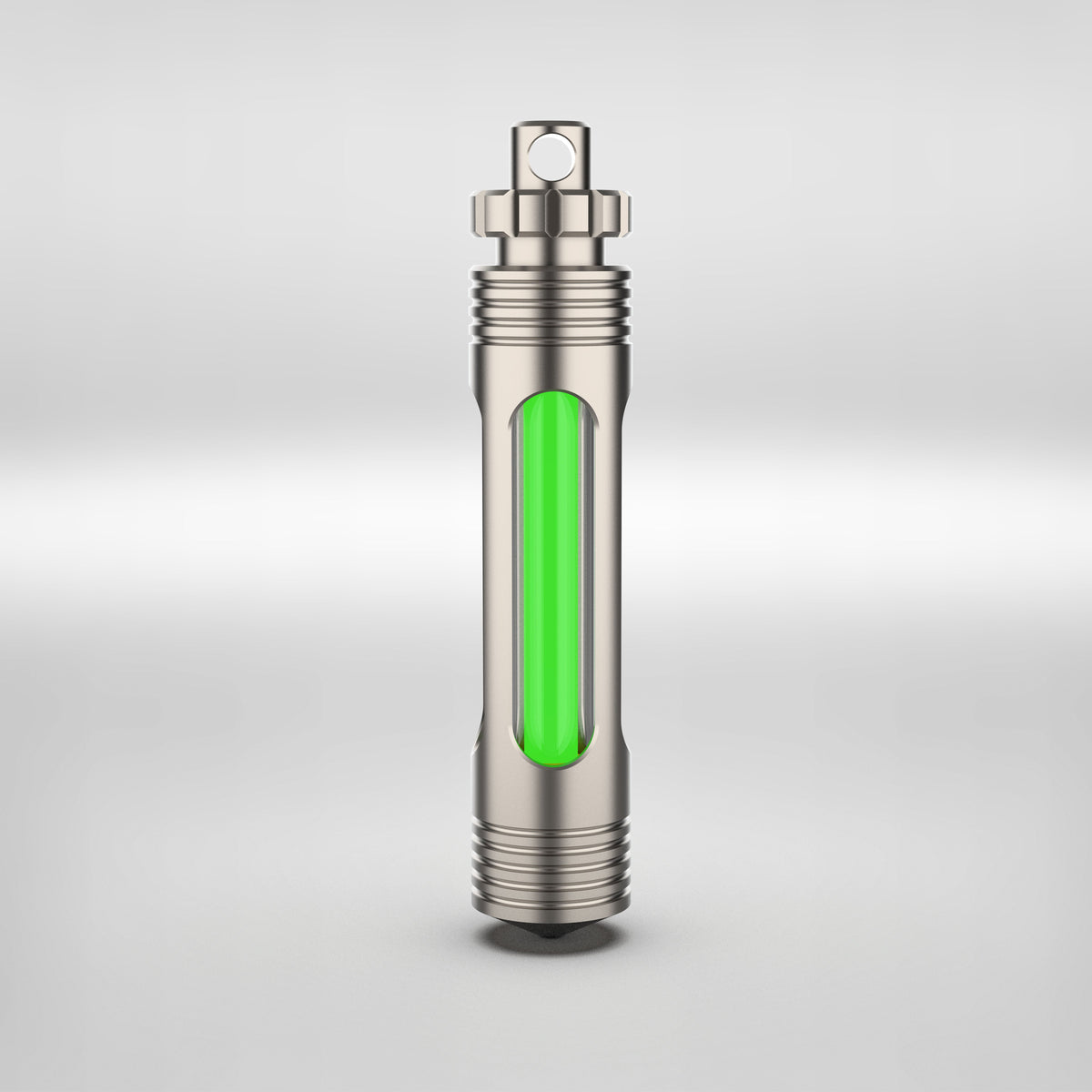
In a housed glow fob, a Grade 5 titanium shell surrounds the glass as well. A Geiger counter held against a sealed tritium keychain may read nothing above background, since the beta particles never leave the vial to be counted. The hazard model for tritium is not about standing near it.
What happens if a tritium vial breaks?
If a vial breaks, the tritium gas disperses into the air, and the exposure from one keychain vial in a ventilated room is minor.
The scenario worth planning for is mechanical failure, with the vial cracking open.
Keychain vials sit inside machined metal housings to prevent exactly that, and a quality titanium fob can absorb much of the knocks and pocket impacts that would otherwise reach the glass. The two ends of a vial are the sealed points, and they break far more easily than the straight body. The failures we see come from clamping the ends during installation, and from drops.
If one does break, the standard guidance is to ventilate the room, step away for a few minutes, keep your face away from the breakage, pick up the fragments with gloves or a damp paper towel, and wash your hands afterward. A single keychain vial holds a small amount of tritium, and the fraction a person could inhale in a ventilated room is a minor exposure. Tritium that does enter the body is cleared quickly: the CNSC gives tritiated water a biological half-life of about 10 days, and drinking fluids speeds that up.
Radium, the glow material of an earlier era, is a different matter. It emits penetrating gamma radiation, deposits in bone and remains dangerous for millennia, and it was removed from consumer products decades ago. Tritium took its place, and its mild failure modes are one likely reason.
How does a tritium keychain compare with everyday radiation?
A sealed tritium keychain adds less exposure than ordinary background radiation, because its beta particles do not leave the vial.
Radiation only makes sense with comparisons, so here are the ones that matter.
Everyone on Earth receives background radiation all the time, from soil, building materials, cosmic rays and the potassium in our own bodies. A typical annual background dose is a few millisieverts. A cross-country flight adds a measurable slice on top, because there is less atmosphere shielding you at altitude, and a banana holds enough radioactive potassium-40 that "banana equivalent dose" became a running joke among physicists.
A sealed tritium keychain sits below all of these, because its beta particles do not leave the vial. The everyday tritium exposure people do receive comes from trace amounts naturally present in rainwater and food, not from a device.
The broken-vial scenario compares well with everyday exposures too. Regulatory assessments of consumer tritium products model that event under unfavorable assumptions and still find doses below the annual variation in natural background between, say, living in Florida and living in Denver. Put plainly, the worst realistic day with one may matter less than your choice of home address.
None of this is an argument for carelessness. It is context for the distance between "radioactive" as a word and tritium's actual hazard profile, and the numbers are how you see that distance.
How do regulators treat tritium keychains?
Consumer tritium products in the United States are distributed under Nuclear Regulatory Commission licensing. The NRC's framework for self-luminous products exists because sealed tritium sources have a long safety record in exit signs, aircraft instruments, dive watches and firearm sights, applications where reliability is measured in decades.
For an owner, buying, owning and carrying a tritium keychain in the US needs no license, no registration and no handling training; the regulatory burden sits with the supplier. Antdesign glow fobs use Swiss-manufactured GTLS vials and are distributed in compliance with US NRC requirements. Our vials are fresh from the Swiss factory, and we sell through them, so there is no ageing stock. We inspect every single vial on arrival, and the defects we find are shipping damage.
Rules differ outside the US, so if you travel or live abroad, read our guides to tritium legality by country and flying with tritium before you pack one.
How should you handle a tritium keychain?
Handle it like any sealed glass part: keep the vial intact, and never open, crush or clamp it. Safe does not mean indestructible. A sealed vial in normal use is not a radiation exposure risk, and every rule below is about keeping it sealed:
- Don't open, drill or machine a housing with the vial installed.
- Don't crush a bare vial or bite it.
- Don't clamp a vial by its ends when fitting it, and handle a loose vial by its straight body.
- If a vial ever breaks indoors, ventilate and step away for a few minutes before cleanup.
- Dispose of a dead or damaged vial through electronics or hazmat collection rather than household trash where local rules require it.
Beyond those there are no storage precautions, no exposure limits to track and no maintenance. For how long the glow lasts and why brightness fades the way it does, see the next guide in this series. If you would rather see the hardware, the full collection is the place to start.
Frequently asked questions
Can a tritium keychain go through airport security?
Sealed tritium devices do not trigger standard airport metal detectors or X-ray alarms in a way that indicates radiation, and small consumer GTLS items can be fine in carry-on luggage. Rules vary by airline and country, so check our flying-with-tritium guide for specifics.
Share:
Tritium Glow Fob: How to Choose a Titanium Keychain That Glows for Years