
Last updated
A finished tritium vial is glowing from the moment its seal closes. In strong light you cannot see the glow, although the vial is glowing the whole time.
A tritium vial is a sealed glass tube, coated inside with phosphor and filled with tritium gas, that glows without a battery. For an object with no moving parts, no electronics and a bill of materials of three items, tritium vials are strikingly difficult to make. Only a handful of facilities in the world produce gaseous tritium light sources, GTLS in the trade. Every step has to happen inside a facility licensed to handle tritium gas, with containment, monitoring and accounting for every atom that goes in, and the result is a component a few millimeters long that glows continuously for up to 25 years and can never be opened.
What glass are tritium vials made from?
Tritium vials are made from borosilicate glass, the same family as laboratory glassware, chosen for thermal shock resistance and chemical inertness. Tritium emits beta particles that cannot pass through the glass or through skin, and a sealed vial in normal use is not a radiation exposure risk.
Manufacturing begins with tube drawing. Glass is heated and pulled down to precise outside diameters, from about 1.5 to 3 millimeters for the sizes used in carry gear, with the wall thickness held tight along the whole length. Dimensional consistency matters more here than it looks: the vial has to fit a machined pocket in a housing with little clearance, and a tube that varies along its length either will not seat or will rattle.
Drawn tube is then cut to length. The sizes on a spec sheet, 2x6, 3x11, 3x22.5 and so on, are diameter by length in millimeters, and they have a large effect on how bright the finished vial will be. 1.5x6 mm is one of the sizes we use often, alongside 2x12 mm and 3x22.5 mm. Larger vials read brighter to the eye: a 3x22.5 mm vial is visibly brighter than a 2x12 mm one.
How does a tritium vial make light?
A phosphor coating on the inside of the tube produces the light, and it is a step where manufacturers can differ a great deal.
A phosphor suspension is introduced into the tube and deposited as an even layer on the inner wall. The coating has to be uniform. Thin patches emit less light and make a vial look blotchy, while thick patches waste phosphor and can absorb their own output. On a tube three millimeters across, "even" is a demanding specification.
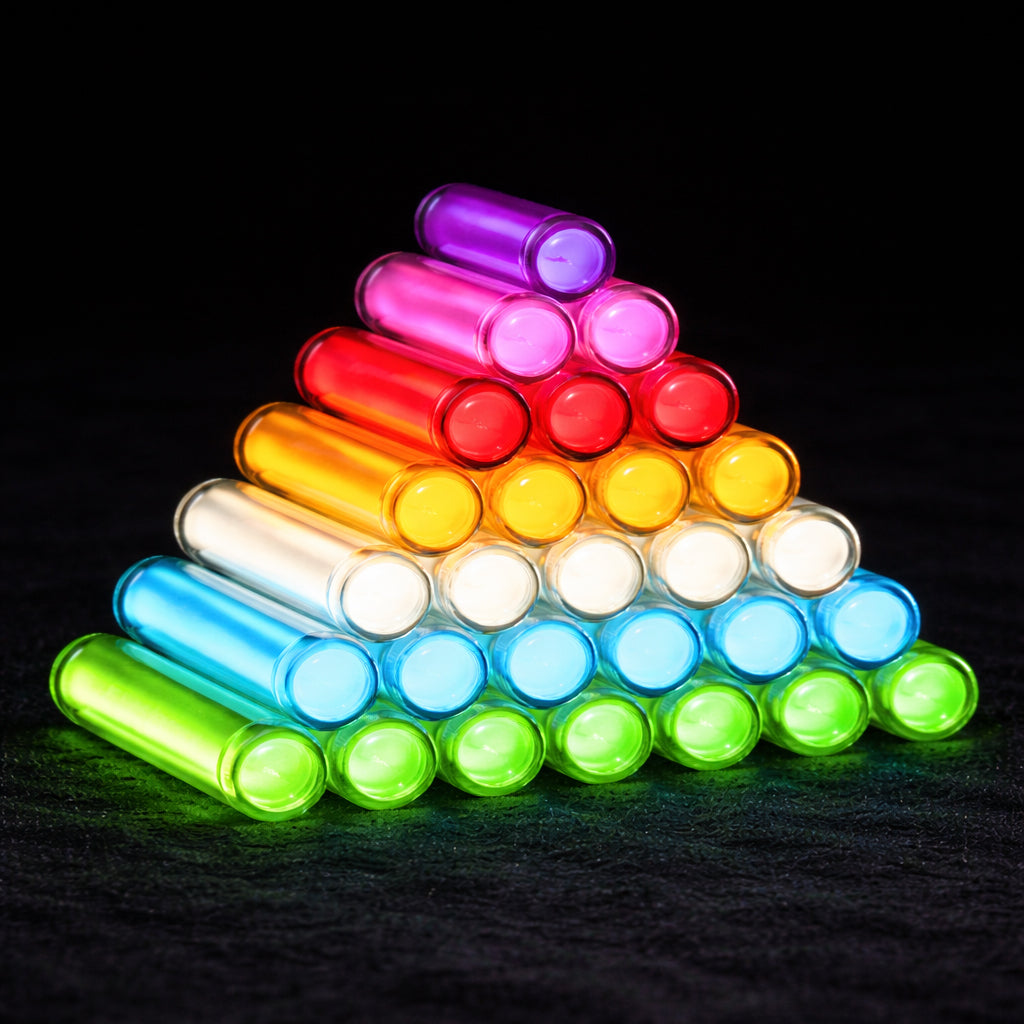
Phosphor chemistry sets the color. Tritium decay is colorless in itself; what you see is the phosphor's emission wavelength. Zinc sulfide-based phosphors doped with different activators give green, blue, yellow, orange and red, and they differ widely in conversion efficiency. Green is both the most efficient of them and the closest to peak human night sensitivity.
Green is the brightest color at every vial size, which is why we lead with green. The full ranking is in our guide to tritium colors and brightness.
Phosphor quality is also one place a cheap vial can save money. The tritium fill is largely fixed by physics and the vial volume, but a lower-grade phosphor costs less, converts less energy into light and can degrade faster under constant bombardment. The difference may be invisible on day one and plain after five years.
How does the tritium gas get into the vial?
The coated tubes go into a filling system inside a containment enclosure, where air is evacuated and a metered amount of tritium gas is introduced at a controlled pressure.
Everything about this step is shaped by one fact: tritium is a gas that must not escape. The enclosure is sealed and monitored, the atmosphere is captured and processed rather than vented, and the facility accounts for its inventory continuously. This part of the process cannot be moved to a cheaper plant, and it is one likely reason the global supplier list is short.
Fill quantity, together with vial volume and phosphor efficiency, sets initial brightness. It is a design decision within limits set by the regulatory framework the facility works under: more tritium means a brighter vial and a higher activity, and the exemption thresholds that let these products be sold as consumer goods put a ceiling on it.
How is a tritium vial sealed?
Each vial is sealed with a laser, which closes the open end of the filled tube while it is still inside containment. The beam melts the glass shut in a fraction of a second and forms a hermetic seal.
A laser is used instead of a torch. Heat stays confined to the seal point, so the phosphor coating and the gas inside are not cooked, and the process is fast and repeatable enough to close thousands of vials with a consistent seal geometry. That consistency matters, because the seal is what stands between the tritium and the outside world for the next quarter century.
The two ends of a vial are the sealed points, and they break far more easily than the straight body. A properly sealed vial holds its fill. A leaking seal is one way a vial ends up disappointingly dim after a few years, and since sealing quality is not something a buyer can inspect, it is a practical argument for buying vials whose manufacturer is named.
How are tritium vials tested before they ship?
Finished vials are checked for contamination, dimensions and visible defects before they leave the facility. Surface contamination testing confirms that no tritium is present on the outside of the glass, dimensional checks confirm the vial will fit the housings it is destined for, and visual inspection catches coating defects and seal irregularities.
Our vials are fresh from the Swiss factory, and we sell through them, so there is no ageing stock. We inspect every single vial on arrival, and the defects we find are shipping damage.
After the seal, nothing more can be done to the vial. It cannot be opened, topped up, recoated or repaired, so every choice is made before the laser fires. A buyer is choosing a finished, permanent component whose only variables are size, color and who made it.
Antdesign uses Swiss-manufactured vials, distributed in compliance with US NRC requirements, and its housings are machined from Grade 5 titanium. Those two halves come from different industries, one a licensed gas-handling operation and the other precision machining, and a finished glow fob is where they meet.
How does a tritium vial go into a keychain?
The vial sits in a machined pocket in the housing, which is the second half of the engineering problem.
A vial pocket has to hold the glass without loading it. Too tight and the housing stresses the tube; too loose and the vial moves under impact and can eventually crack. The pocket is machined to the vial's nominal dimensions with controlled clearance, and the retaining method, a screw-down cap, a threaded insert or a press-fit window, determines whether the vial can ever be changed. The failures we see come from clamping the ends during installation, and from drops.
A design that lets the vial be removed can be re-vialed years from now instead of thrown away, which is the subject of our guide to replacing a tritium vial. A glued or potted vial is permanent in the wrong sense.
Material matters as well. Grade 5 titanium is stiff and corrosion-proof, and it does not deform around the pocket the way soft aluminum can after a few years on a keyring. To see how the different housings hold the same vial sizes, the full collection lays them out side by side.
Why are tritium vials expensive?
The raw materials are cheap, but the conditions needed to assemble them are not. Add it up: a licensed facility with tritium containment, precision glass drawing, an even coating a few microns thick inside a three-millimeter tube, metered gas filling, laser sealing and contamination testing, for a part smaller than a grain of rice, made by a handful of plants worldwide.
A listing offering the same glow for a fraction of the price may be telling you something about its phosphor, its fill or its seal that it has not put in writing. We have handled cheaper non-Swiss vials, and the plain difference is that they are not as bright as ours.
Frequently asked questions
Where are tritium vials manufactured?
Only a small number of licensed facilities worldwide produce gaseous tritium light sources, with Switzerland the best known center of production. The barrier is regulatory and technical rather than commercial, which is why the supply chain is so concentrated.
Can tritium vials be made or refilled at home?
No. Filling requires tritium gas, containment equipment, and an authorization to hold the material, and the seal requires laser equipment. A finished vial is permanently closed and cannot be opened, refilled, or repaired.
Share:
Is Tritium Legal? US, UK, Canada and EU Rules Compared
Tritium Colors Ranked by Brightness: Green, Ice Blue and Beyond