
Last updated
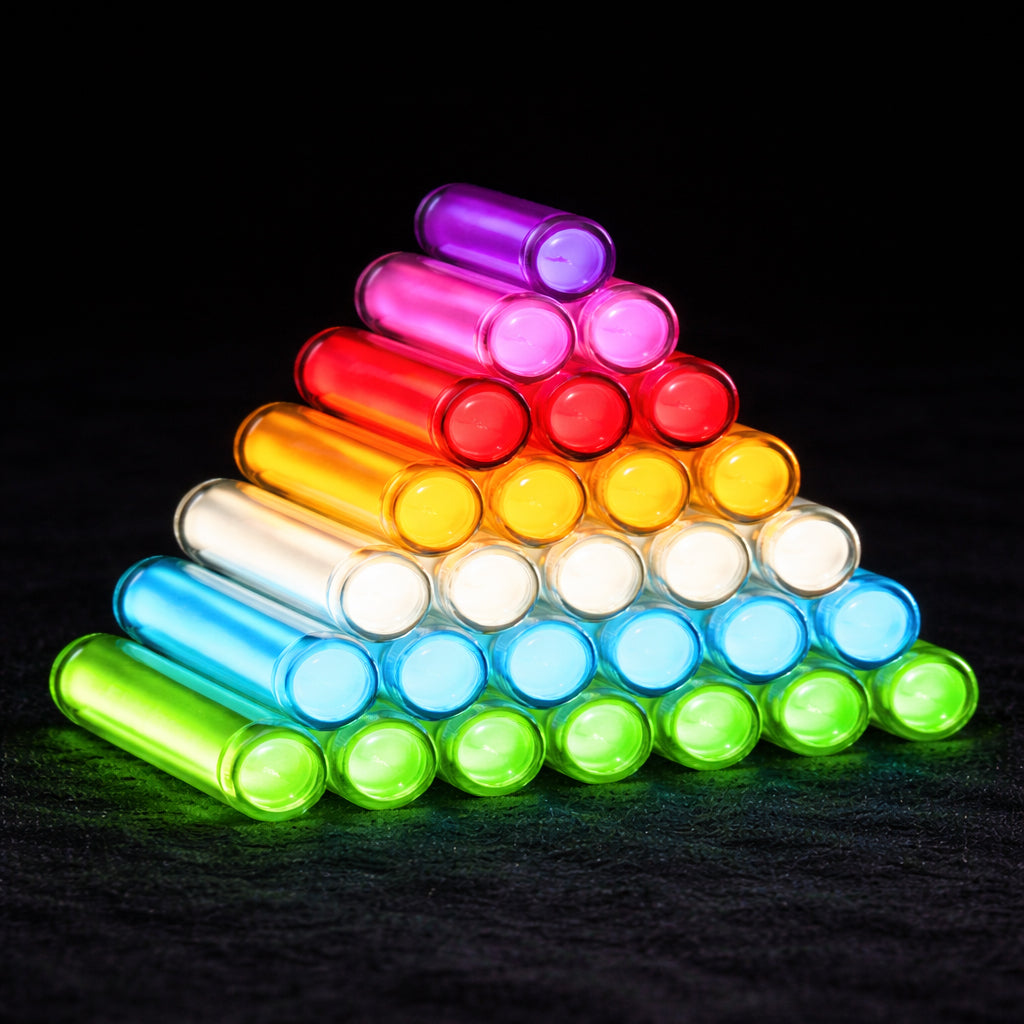
Put a green vial and a red vial side by side in a dark room and the ranking is obvious in a second. What catches people out is the size of the gap. Color is not a cosmetic choice with a small brightness penalty attached: the difference between the brightest and dimmest tritium vials is large enough to change what a vial is good for.
A tritium vial is a sealed glass tube filled with tritium gas and coated inside with a phosphor, and the phosphor is what sets its color.
Which tritium color is the brightest?
Green is the brightest tritium color, followed by ice blue and yellow, with orange, blue, red and purple progressively dimmer. The same ranking applies to all tritium vial colors, whether the vial sits in a keychain, a lanyard bead or a bag of loose vials. As a dark-adapted eye sees them, at the same vial size:
| Rank | Color | In the dark |
|---|---|---|
| 1 | Green | Brightest; the reference for the rest |
| 2 | Ice blue | Noticeably dimmer, still easy to see |
| 3 | Yellow | Mid-pack, with a warmer look |
| 4 | Orange | Dimmer again, distinctive |
| 5 | Blue | Deeper than ice blue, and dimmer |
| 6 | Red | Among the dimmest; strong character |
| 7 | Purple | Dimmest common color |
Green is the brightest color at every vial size, which is why we lead with green.
Treat the table as an ordering, not a set of ratios. Exact output varies between manufacturers and between production batches, and the numbers quoted in listings may not be measured under conditions you can compare. The order itself comes from the underlying chemistry, so it holds across reputable manufacturers.
Why is green tritium brighter than other colors?
Green is brighter because its phosphor turns the energy from the tritium into light more efficiently than the phosphors used for the other colors. The tritium inside every vial is the same. It emits low-energy electrons at a rate set by physics, not by color. Tritium emits beta particles that cannot pass through the glass or through skin, and a sealed vial in normal use is not a radiation exposure risk. What differs from one color to the next is the phosphor coating those electrons hit.
Phosphors convert incoming energy into photons at a specific wavelength, and they are not equally good at it. The zinc sulfide-based phosphor used for green is the most efficient of the practical options, while the phosphors that emit at the red and purple ends of the spectrum convert a smaller fraction of the same input energy into light.
There is a wavelength cost too. Producing a photon of shorter wavelength takes more energy per photon, and some color phosphors involve additional conversion steps that lose energy along the way. Neither is a manufacturing defect that a better factory could fix; both are properties of the materials available.
Why do red and purple tritium look so dim?
Red and purple look dim for two reasons: their phosphors produce less light, and the dark-adapted human eye is less sensitive to red than to green.
Human vision in the dark is dominated by rod cells, which peak in sensitivity around the blue-green part of the spectrum and fall off sharply toward red. In dark-adapted conditions, red light is perceived as much dimmer than green light of the same physical intensity. That is also why red light is used to preserve night vision, and why a red vial can look fainter than its measured output suggests.
A green vial is producing more light and being seen by the part of your visual system best tuned to receive it. The dimmest colors lose on both counts, so the perceived gap between green and purple can be bigger than an efficiency table alone would predict.
Light around you matters as well. In strong light you cannot see the glow, although the vial is glowing the whole time. A color comparison only means something in the dark.
Does the color change how long a tritium vial stays useful?
Yes, because every vial fades along a broadly similar curve, so a dimmer color starts closer to the point where it stops being useful. The color you choose sets where on that curve you start, and with it how long the vial stays genuinely useful. Our vials are fresh from the Swiss factory, and we sell through them, so there is no ageing stock.
A green 3x11 mm vial starts high and stays above "easy to find in a dark room" for many years of a glow that lasts up to 25 years. A purple vial of the same size starts much closer to that threshold and crosses it sooner.
Size is the fix. A large vial holds more tritium and presents more coated surface, so moving from 3x11 mm to 3x22.5 mm can buy back some of the brightness a dim color costs. Larger vials read brighter to the eye: a 3x22.5 mm vial is visibly brighter than a 2x12 mm one. 1.5x6 mm is one of the sizes we use often, alongside 2x12 mm and 3x22.5 mm. If you want red or purple on a fob you will rely on, buy it in the largest size the housing accepts. How brightness declines over time is covered in our tritium vial lifespan guide.
What is the best tritium color for a keychain?
Green is the best color for a keychain whose job is to be found in the dark. It is the brightest, it stays usable longest, and it can be the quickest to register when you are half awake and looking for your keys. A green tritium keychain is the default choice.
Ice blue is the sensible second choice when you want something other than green. The brightness cost is real but modest, and the color is distinctive without being faint.
Below that, color becomes a preference decision rather than a performance one. Choose orange, red or purple because you want that specific look, and size up to compensate. What to avoid is buying a small purple vial expecting green-level visibility and concluding the product is faulty.
Color can also work as a code. Different colors on different keys, bags or tools let you identify what you are holding by glow alone, which is one job a dimmer color can do that green cannot.
How do you compare brightness claims in tritium listings?
Compare the stated vial size and the named vial manufacturer before any brightness number, because listings quote brightness in ways that are hard to compare. Some quote microlamberts or candela per square meter. Those are real units, but they only mean something if you also know the vial size, the measurement distance and the age of the sample. A percentage relative to green is at least a ratio, though the baseline is not always stated. Other listings quote nothing and rely on a long-exposure photograph, which makes every color look equally bright and tells you nothing.
The stated vial size is worth more than any number in the listing, because size has a large effect on output. So is a named vial manufacturer, because phosphor quality is one place cost can be cut and it may not show until years later. We have handled cheaper non-Swiss vials, and the plain difference is that they are not as bright as ours.
Photography can help too. A seller confident in a dim color has every reason to show it next to green in one frame rather than alone. If a listing gives you a color name and nothing else, treat that as a warning that the vial may be small and the phosphor unremarkable.
Can you mix tritium colors on one keychain?
Yes, and one green vial alongside decorative colors gives you both visibility and the look you want. When a fob carries several vials, total output is what you notice. Combinations that can work well: green with ice blue for a cool, high-visibility look, green with orange for contrast, and ice blue with purple where appearance is the point.
Some collectors seek out the dim colors because they are less practical; a purple vial is uncommon and can look striking against titanium. Keep at least one green vial on the keys you need to find, and treat the rest as the collection they are.
To compare the colors side by side, the full collection shows the current color and size options in one place, and the buying guide covers how housing and vial size interact with the color you choose.
Share:
How Tritium Vials Are Made (GTLS Manufacturing)