
Last updated
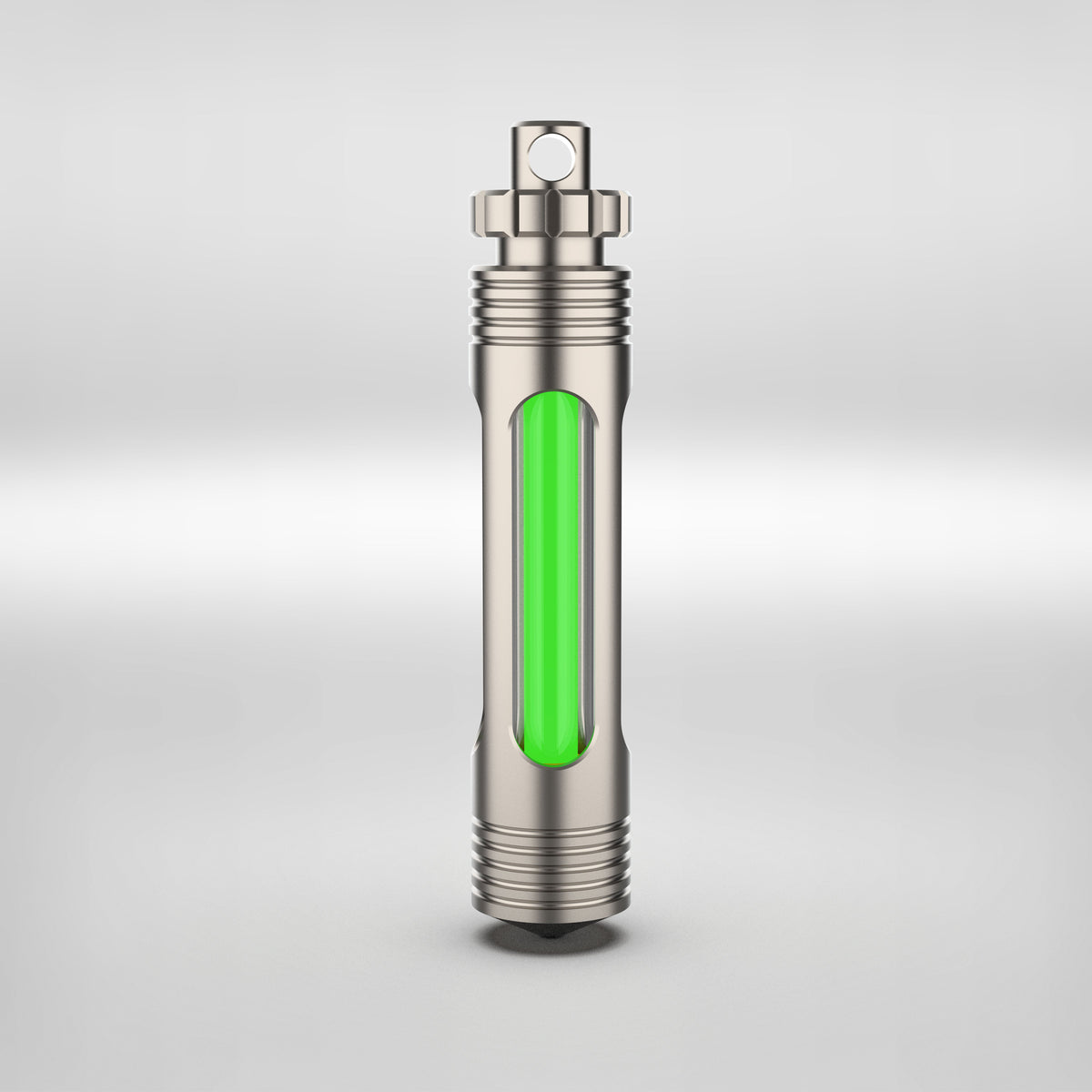
On a nightstand with the lights off, a glow fob is the one thing on a keyring you can still see: a small machined body with a point of light set into it. It rides on keys most often, then on bags, zipper pulls, tools, and gear you have to find by touch inside a pack.
A glow fob is a small machined body, often metal, that carries a glowing element and attaches to something you need to find in the dark. The rest comes down to which glowing technology it uses and how well the body is made.
Why is it called a glow fob?
It is called a glow fob because a fob is a small object that rides on a keyring, and this one glows. A fob, in the original sense, is a small ornament attached to a chain. In everyday carry it has come to mean any compact object that rides on a keyring: a bottle opener, a pry bar, a bead, a marker.
Related terms describe the same object from different angles. Glow marker emphasizes the function. Tritium fob or tritium keychain specifies the technology. Keyring fob, common in British usage, describes the attachment. In practice they are interchangeable, and a listing under any of them describes the same product.
A glow fob is the object, while tritium is one of two ways to make it glow. Not every glow fob contains tritium.
What makes a glow fob glow?
A glow fob glows either from glow-in-the-dark material charged by light or from a sealed tritium vial that needs no charging at all.
Photoluminescent means glow-in-the-dark material, often a strontium aluminate pigment in a resin insert. It absorbs light, stores the energy and releases it slowly. Right after a bright charge it can outshine a tritium vial. Then it decays steeply: it can be strong for twenty or thirty minutes, faint within a couple of hours, and hard to see at all by the middle of the night. If it has spent the day in a dark bag, it does nothing.
Radioluminescent means a sealed tritium vial: a borosilicate glass tube containing tritium gas, with a phosphor coating on the inner wall. Tritium decay releases beta particles, low-energy electrons that strike the phosphor continuously. That chain of gas, beta particles and phosphor is how tritium vials work in every glow fob, watch hand and gun sight. Those beta particles cannot pass through the glass or through skin. A sealed vial in normal use is not a radiation exposure risk.
There is no charging, no light exposure and no battery. A tritium vial is dimmer than freshly charged glow material and does not depend on having seen daylight, so it glows the same at 3 a.m. as it did at midnight, and keeps doing so for up to 25 years. In strong light you cannot see its glow, although the vial is glowing the whole time.
| Glow-in-the-dark | Tritium vial | |
|---|---|---|
| Energy source | Light it has absorbed | Tritium decay, no charging |
| Later in the night | Fades steeply | As bright at 3 a.m. as at midnight |
| After a day in a dark bag | Does nothing | Unaffected |
Neither is better in the abstract. The full side-by-side comparison, including a night-by-night brightness table, is in our guide to tritium versus glow-in-the-dark paint.
Some good fobs use both. A glow-in-the-dark insert next to a tritium vial gives a bright burst when you leave a lit room and a steady marker for the rest of the night.
What is inside a tritium glow fob?
A tritium glow fob has a machined body, a vial pocket, a sealed tritium vial, a cap or screw to retain it, and sometimes a shock-absorbing sleeve.
The body. A machined block with a pocket sized to the vial, a hole for the keyring, and whatever chamfers and knurling give it its shape and grip. Much of the cost, and much of whether the fob survives, sits here.
The vial pocket. A bore machined to the vial's nominal dimensions with controlled clearance. Too tight and the housing loads the glass; too loose and the vial moves under impact and can eventually crack. Much of the engineering in the product is getting this right. The two ends of a vial are the sealed points, and they break far more easily than the straight body. The failures we see come from clamping the ends during installation, and from drops.
The vial. A sealed glass tube, sized in millimeters as diameter by length: 3x11 mm is the standard keychain size, 3x22.5 mm the large format, 2x6 mm an accent size. 1.5x6 mm is one of the sizes we use often, alongside 2x12 mm and 3x22.5 mm. Larger vials read brighter to the eye, and a 3x22.5 mm vial is visibly brighter than a 2x12 mm one. Color comes from the phosphor. Green is the brightest color at every vial size, which is why we lead with green. Ice blue is the strong second, and red and purple are the dimmest.
Our vials are fresh from the Swiss factory, and we sell through them, so there is no ageing stock. We inspect every single vial on arrival, and the defects we find are shipping damage.
The retention. A threaded cap, a retaining screw, or a press-fit window that holds the vial in. It is one of the most consequential design choices in the product.
Sometimes a sleeve. A rubber or silicone shock-absorbing insert between the vial and the pocket wall, which takes impacts the glass would otherwise see.
Why does the housing of a glow fob matter?
The housing protects a fragile glass vial from keys and knocks, and the way it retains the vial decides whether the fob can outlive it. A glowing element on its own is not built for daily carry.
Material sets the ceiling. Grade 5 titanium suits fobs meant to be carried: hard, corrosion-proof, dimensionally stable, and light enough that it does not drag on a keyring. Stainless steel works and weighs more. Aluminum is one place cost can be cut, since the anodizing can wear through against keys within months and the softer body can deform around the vial pocket over years. Brass and copper tend to be picked for patina rather than protection.
Retention shapes the product's lifespan. No customer has come back to us reporting a vial going dim. Every vial does dim gradually over its glow life, though, and at some point you may want a fresh one. A housing with a threaded cap or retaining screw makes that a few minutes of hand work, so the vial becomes a consumable and the glow fob becomes something you keep. A glued or potted vial means the fob and the vial reach the end together. Our guide to replacing a tritium vial walks through what the swap involves.
Two fobs can look identical in a photograph and differ on both of these points.
What are glow fobs used for?
The plainest use is finding keys in the dark: on a nightstand, in a bag, in a car footwell, dropped on a trail.
A fob can also mark a specific key by touch and glow, so you can pick it out without light. On a bag it can sit on the zipper pull of the compartment you need at night, and inside a dark pack it can mark a headlamp, a first-aid pouch or a tool. After a power cut, when everything electronic is useless, a self-powered marker still shows where the gear is.
There is a collecting side as well. Different colors, vial sizes, housing shapes and finishes make for a set people enjoy owning, and some multi-vial builds exist because they look extraordinary rather than because anyone needs that much light.
How do you choose a glow fob?
A good choice comes down to the technology, housing material, vial size, color and serviceability.
- Technology. Tritium if it has to work at 4 a.m. or in a bag that never sees light. Glow-in-the-dark if it lives in lit rooms and cost matters. Both, if the fob offers it.
- Housing material. Grade 5 titanium for daily carry; steel if you do not mind weight; skip aluminum for anything you want to keep.
- Vial size. 3x11 mm for a normal keychain, 3x22.5 mm if you want it obvious across a room.
- Color. Green for maximum visibility and longest useful life; anything else for looks, sized up to compensate.
- Serviceability. A removable vial, ideally from a seller that stocks spares.
The vial's source matters too. We have handled cheaper non-Swiss vials, and the plain difference is that they are not as bright as ours.
Our buying guide goes deeper on each point, including the red flags in cheap listings, and the full collection shows the current housings, vial sizes and colors side by side.
Frequently asked questions
Is a glow fob the same as a keyring?
Not quite. The keyring is the metal loop; the fob is the object attached to it. In British English a fob is often called a keyring fob or keyring charm, which is worth knowing when comparing product listings between markets.
Share:
Replacing a Tritium Vial: When, Why and How