
Last updated
No customer has come back to us reporting a vial going dim. A tritium vial does dim, though, so gradually that the fade never announces itself. There is no flicker, no dead battery and no moment where the thing stops working; some evening years from now you notice that you are hunting for a fob you used to spot instantly.
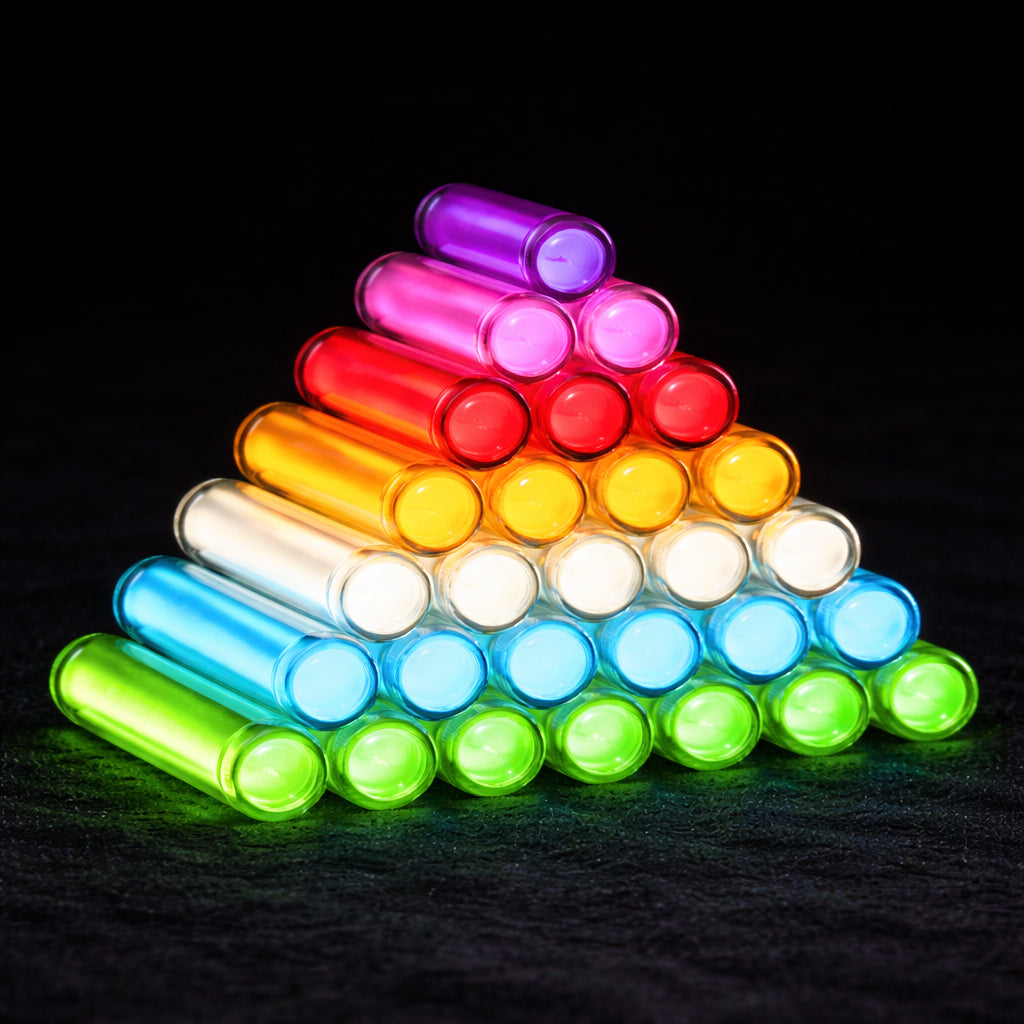
A tritium vial is a sealed glass tube filled with tritium gas and coated inside with a phosphor that glows without any power source. So the question is not whether the vial has failed. It is whether the vial is still doing its job.
When should you replace a tritium vial?
Replace a tritium vial when you can no longer spot it straight away in a dark room once your eyes have adapted. A vial glows for up to 25 years and dims steadily the entire time, so there is no calendar date at which it becomes wrong. A dark room answers the question better than a date.
Go into a genuinely dark room and wait a full minute for your eyes to adapt. Testing under a hallway light tells you nothing. In strong light you cannot see the glow, although the vial is glowing the whole time. Then look for the fob.
If you see it immediately, it is fine. If you have to search, or you find yourself squinting at where you know it is, it has crossed the line from marker to decoration, and that is the moment to swap.
Small vials start closer to that threshold, so a 2x6 mm vial can reach it years before a 3x22.5 mm one. Larger vials read brighter to the eye; a 3x22.5 mm vial is visibly brighter than a 2x12 mm one. Dim colors such as red, orange and purple also reach the threshold sooner, because they begin with less perceived output, and green vials in standard or large sizes can stay useful the longest. The mechanics of the decline are covered in our tritium vial lifespan guide.
Why replace a tritium vial that still glows?
Damage, a change of mind about color or size, and refreshing an older fob are all reasons to replace a vial before it fades.
Damage. A cracked vial vents its tritium and goes dark permanently, the one genuinely sudden failure. The two ends of a vial are the sealed points, and they break far more easily than the straight body. The failures we see come from clamping the ends during installation, and from drops. A well-machined housing makes damage in carry less likely, because the metal takes the impacts instead of the glass.
A change of mind about color or size. Some swaps have nothing to do with age. Going from ice blue to green for visibility, or from 3x11 mm to 3x22.5 mm for brightness, is a legitimate reason to open the housing.
Refreshing an older fob. A titanium body can outlast several vials, and re-vialing a fob you have carried for a decade costs less than a new one while keeping the piece that carries your wear pattern.
How do you replace a tritium vial?
On a housing designed for it, you open the cap or screw, tip the old vial out, clean the pocket, slide the new vial in by its body and close it up. It is simple hand work and may not need any adhesive. The same steps are how to install tritium vials in a housing for the first time, since a new build and a replacement differ only in whether an old vial comes out first.
- Work over a soft surface. A cloth or a mat, in good light. The vial is small glass and the retaining hardware is smaller, and both will find the gap under the workbench if you let them.
- Open the retention. Unscrew the threaded cap or back out the retaining screw. A driver that fits the fastener properly prevents a rounded head.
- Remove the old vial. Tip the housing so the vial slides into your palm rather than prying it out. Do not grip it with pliers or force it against the pocket wall.
- Check the pocket. Clear out pocket lint and debris. A clean pocket lets the new vial seat fully without being loaded at one end.
- Seat the new vial. Slide it in by its straight body, in the same orientation the old one came out. It should drop into place; if it needs force, something is wrong, possibly the wrong vial size or debris in the pocket.
- Close it up. Snug the cap or screw firmly enough that it will not back out, and no further. Over-torquing a retaining cap onto a glass tube can break a brand new vial.
If your fob uses a rubber sleeve or shock-absorbing insert around the vial, replace that at the same time. It is the part that has been absorbing the impacts, and it is cheap.
Is it safe to handle an old tritium vial?
An intact vial is safe to handle. Tritium emits beta particles that cannot pass through the glass or skin, and a sealed vial in normal use is not a radiation exposure risk. Treat the old vial as fragile glass, not as a radiation source. The physics is covered in full in our guide to tritium keychain safety.
The handling rule that matters is mechanical: do not crush, cut, drill or otherwise deliberately open a vial. It applies to the old one as much as the new one, and it is a good reason to move a retired vial straight into a container rather than leave it loose in a drawer where it can be stepped on.
If a vial does break, ventilate the room, step away for a few minutes, and clean up with gloves or a damp paper towel rather than bare hands. Wash your hands afterward and take the debris to hazardous waste collection. Tritium disperses as a gas and dilutes rapidly in air, and a single keychain vial contains a very small amount.
How do you dispose of an old tritium vial?
Take it, intact, to a household hazardous waste collection point or an electronic waste facility. Do not put a retired vial in household trash where local rules say otherwise. Both are equipped to take small items containing regulated materials, and they may be free for households.
If you cannot find a local route, contact your municipal waste authority and describe the item accurately: a small sealed glass tube containing tritium, from a consumer keychain. That description is likely to get you the correct answer faster than asking about radioactive waste, a category built for industrial quantities.
Keep the vial intact until you hand it over. An intact vial is a contained item, while a broken one is a cleanup.
How do you choose the right replacement tritium vial?
Match the diameter and length of the old vial exactly, then pick whatever color you want.
Vial sizes are expressed as diameter by length in millimeters, and housings are machined to a specific one. 1.5x6 mm is one of the sizes we use often, alongside 2x12 mm and 3x22.5 mm. A 3x11 mm pocket takes a 3x11 mm vial and nothing else; a shorter vial rattles and a longer one will not seat. If you do not know your size, measure the old vial or check the product listing you bought from.
Color is your one free choice at swap time, and some people change their mind at that point. Green is the brightest color at every vial size, which is why we lead with green. Ice blue is the strong alternative, and the warmer colors look excellent and are dimmer. The colors guide has the full ranking, and current sizes and colors are listed in the full collection.
Buy from a source that names the vial manufacturer. Phosphor quality can be the difference between a replacement that performs like the original and one that disappoints in five years, and it is not something you can inspect. Our vials are fresh from the Swiss factory, and we sell through them, so there is no ageing stock. We have handled cheaper non-Swiss vials, and the plain difference is that they are not as bright as ours.
Can every tritium keychain take a new vial?
No, a fob whose vial is glued or potted in cannot take a new one. On those, the fade is terminal: when the glow goes, the product goes with it, however good the machining was.
A removable vial therefore belongs on the checklist before you buy rather than a decade later. A tritium keychain with a threaded cap or retaining screw turns the vial into a consumable and the housing into something you keep, a materially different product from one that looks identical in a photograph. Our buying guide covers what else to check at the same time.
Share:
Tritium Keychain Buying Guide: Housing, Vial Size and Value
What Is a Glow Fob? Anatomy of the EDC Glow Marker